
“Our lives end the day we become silent about things that matter.” Martin Luther King.
“The world’s biggest problem is that not enough people work on the world’s biggest problem.” Max Marmer.
“The significant problems we face cannot be solved at the same level of thinking we were at when we created them.” Albert Einstein.
Jensen Huang: “If you look at AI-native, the top AI-native startups that are generating revenues, last year was $2 billion. This year is $20 billion. Next year, being 10x higher than this year is not inconceivable.”
Bret Taylor: “We’re basically going from making something scarce to making it abundant. We did it with power. We did it with transportation. And now we’re dealing with intelligence. And I think that if you look at the impact of electrifying the world … you look at the impact of fruit production the way it is now, what percentage of society worked in agriculture 200 years ago vs. today. I just think we haven’t actually absorbed how impactful that will be. …It’s hard for me to imagine going into a supermarket and not getting the food I want, just like it’s hard me for to imagine going into a room and not being able to flip on a light switch to have the lights go on. 10 years from now, for people younger than us to imagine a world where intelligence is not abundant, which is kind of a mind-blowing thing to think about.”
Factsheet Commentary


For our full Factsheet, link here.
Results Season
Arista
“…the momentum continues. The breadth and depth of our customer interactions have never been stronger nor more exciting…there is no concern on our demand. I think the shipments and the revenue follows based on our supplies. So, if we’re able to make the shipments, then the revenue as you saw in Q2 blew past any of our guidance. However, there are times we can’t ship everything despite the demand…I wouldn’t read too much into the quarterly variances. But I would say we have never felt more strongly about the demand aspect of this, reflected in the continued commitment to 20% growth even though the number keeps increasing. So, no change in demand, some variation in shipments.”
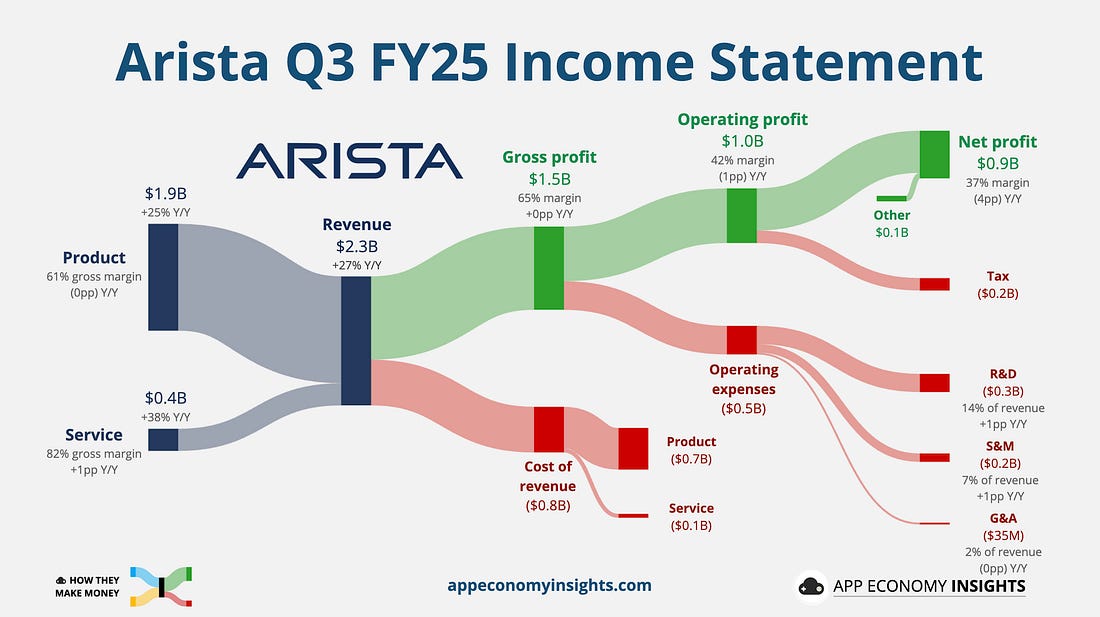
Arista’s Q3 revenue climbed 27% Y/Y to $2.3 billion ($40 million beat), Gross margin was strong at 65%. AI and cloud demand remain the key drivers. Management confirmed its $1.5 billion AI revenue target for 2025 is “well underway” and introduced a massive 2026 AI revenue target of $2.75 billion. In addition, Management reaffirmed its $750-$800 million campus networking target for 2025 and set a 2026 campus target of $1.25 billion. These targets plus a Deferred Revenue surge to $4.7 billion (up from $4.1 billion in Q2), reflect ramping customer demand.
Advanced Micro Devices
“Our data center, AI, server and PC businesses are each entering periods of strong growth…The demand for compute has never been greater as every major breakthrough in business, science and society now relies on access to more powerful, efficient and intelligent computing. These trends are driving unprecedented growth opportunities for AMD…we’re seeing our customers are giving us some visibility in the next few quarters that they see elevated demand, which is positive…given what we see today, we see a very good demand environment into 2026.

As a promising signal, downloads of AMD’s ROCm stack are up ~10× year-over-year, supported by AMD’s developer cloud, university programs, and day-zero model support across PyTorch, TensorFlow, Hugging Face, and Triton. The hardware of AMD is very comparable to NVDA’s so the key is catching up to CUDA which is NVDA’s software stack. But check out how far ahead NVDA started: CUDA development kicked off inside NVIDIA around 2004 and went public in 2006–2007; AMD’s ROCm effort spun up with the 2015 Boltzmann Initiative and shipped its first public releases in 2016.
Moving to server CPU, AMD continues to see above-market growth, targeting >50% share in the next 3–5 years. They also made a compelling case that the growth rate is expanding as a result of AI.

NVDA is the titan of the industry and this was starkly evidenced by AMD’s desperate and dilutive warrant deal it initiated with OpenAi last month. Nonetheless, the tide is rising so fast and the need for an alternative to NVDA is acting as a tailwind for AMD, so we are happily weighted with a ~3.5 per cent of NAV holding.
Celsius
Celsius’s Q3 revenue surged 173% Y/Y to $725 million ($9 million beat). The massive top-line growth included a 99% year-over-year jump in Alani Nu revenue and an $18 million contribution from the newly acquired Rockstar brand (handed over by Pepsico this quarter). This combined portfolio now commands over 20% of the US energy drink market.
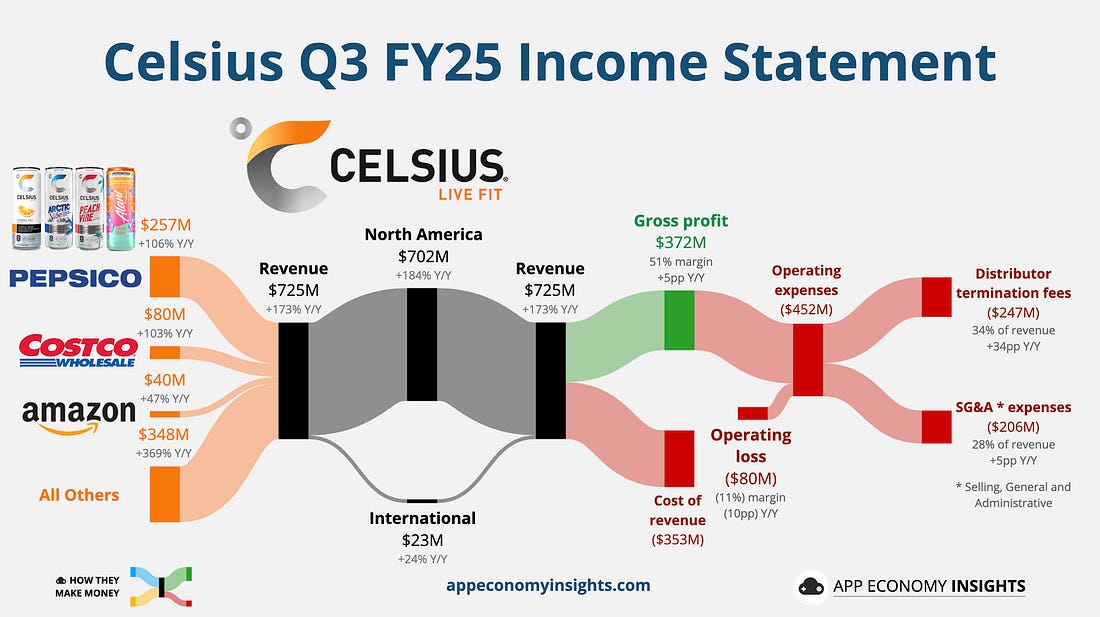
Q4 will be a “noisy” quarter due to the complex transition of the Alani Nu brand into PepsiCo’s distribution network starting in December. Management expects this to temporarily distort sales (as old distributors return inventory and Pepsi builds new stock). Not the time to panic. CEO John Fieldly stressed the move is strategic, cementing Celsius’s role as Pepsi’s “US Strategic energy drink captain,” with financial benefits expected to materialize in Q1 2026. Celsius is becoming to Pepsico what Monster has been to the Coca-Cola company for many years, that could be a great thing for CELH shareholders.
Intuitive Surgical
Intuitive Surgical materially beat Q3 expectations, with revenue soaring 23% Y/Y to $2.5 billion ($100 million beat) and adjusted EPS jumping 30% to $2.40 ($0.41 beat). Great results from a Medical Robotics stock.
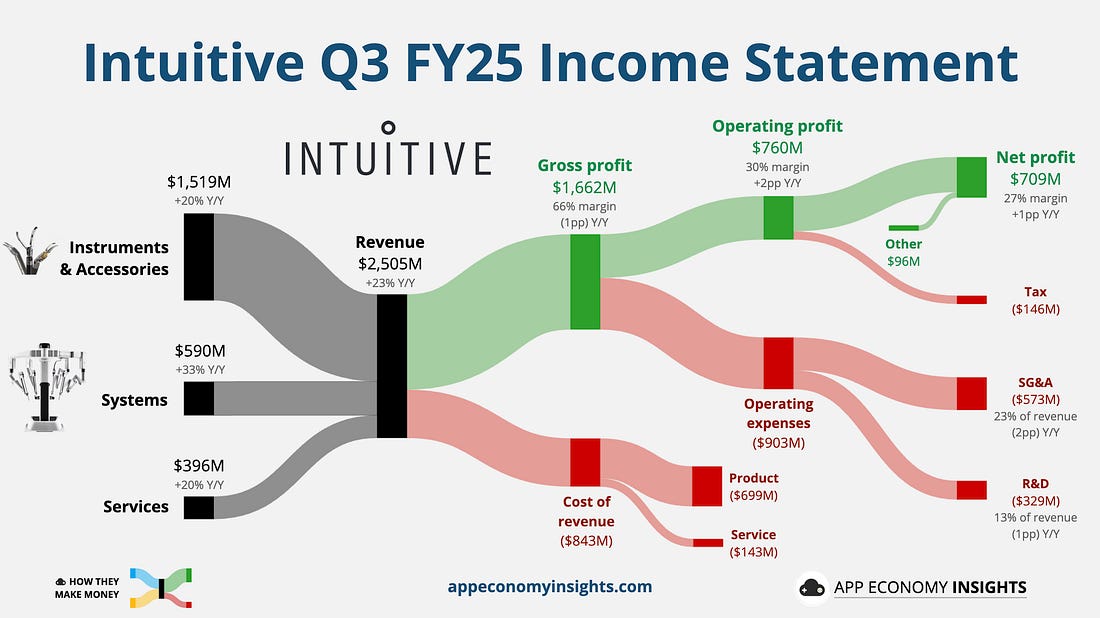
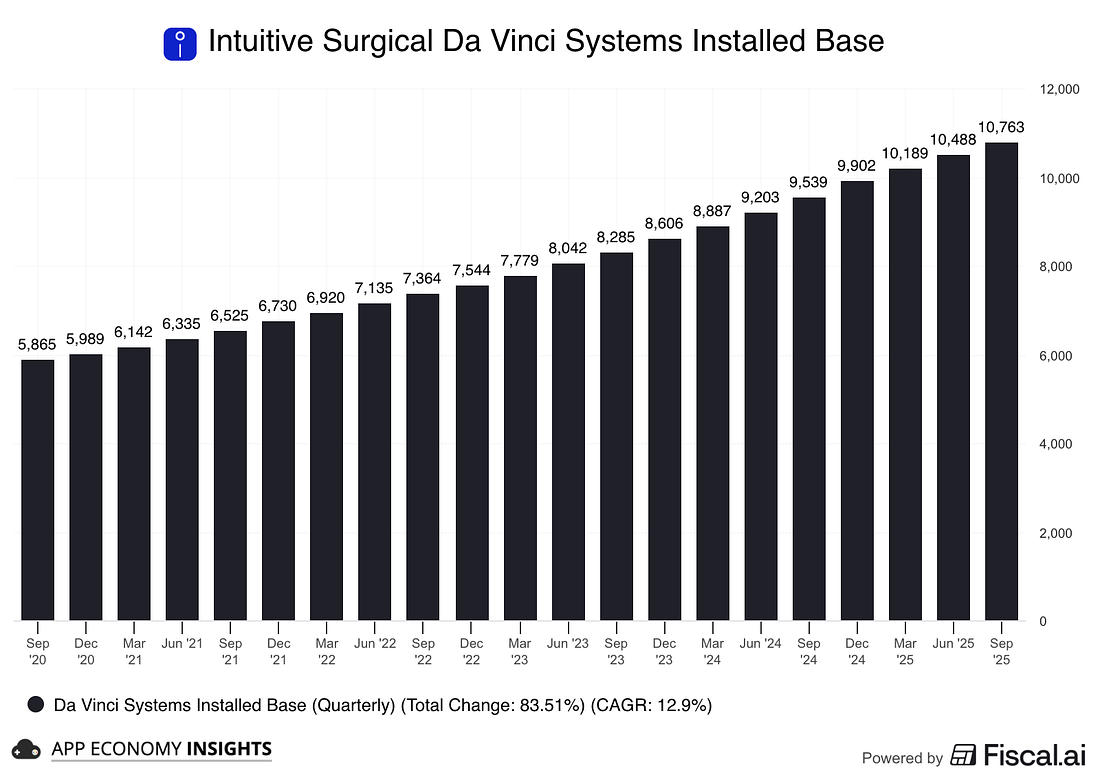
Growth was fuelled by 20% procedure growth (da Vinci +19%, Ion +52%) and accelerating da Vinci 5 adoption. The company placed 427 da Vinci systems, including 240 da Vinci 5 units (up significantly from 180 in Q2), driving its global installed base higher. Recurring revenue remained strong at 85% of the total. Some FMs love what are known as Installed Base stocks – check this chart to understand what this means:
Intuitive raised its FY25 gross margin forecast to 67%-67.5% (from 66%-67%), citing better cost leverage and a lower-than-expected tariff impact (now ~0.7%). Q3 operating margin improved to 30%. Management signalled continued strength by raising FY25 procedure growth guidance to 17%-17.5% (from 15.5%-17%). The international rollout of da Vinci 5 has begun, with first placements in Japan and Europe. The company also repurchased $1.9 billion in stock, and we love share buy backs.
ASML
Bookings remained robust at €5.4 billion, easily surpassing estimates (€0.5 billion beat), driven by a material €3.6 billion in new orders for its most advanced EUV machines as the AI boom continues. Gross margin improved to 52%, beating consensus and landing at the high end of guidance.
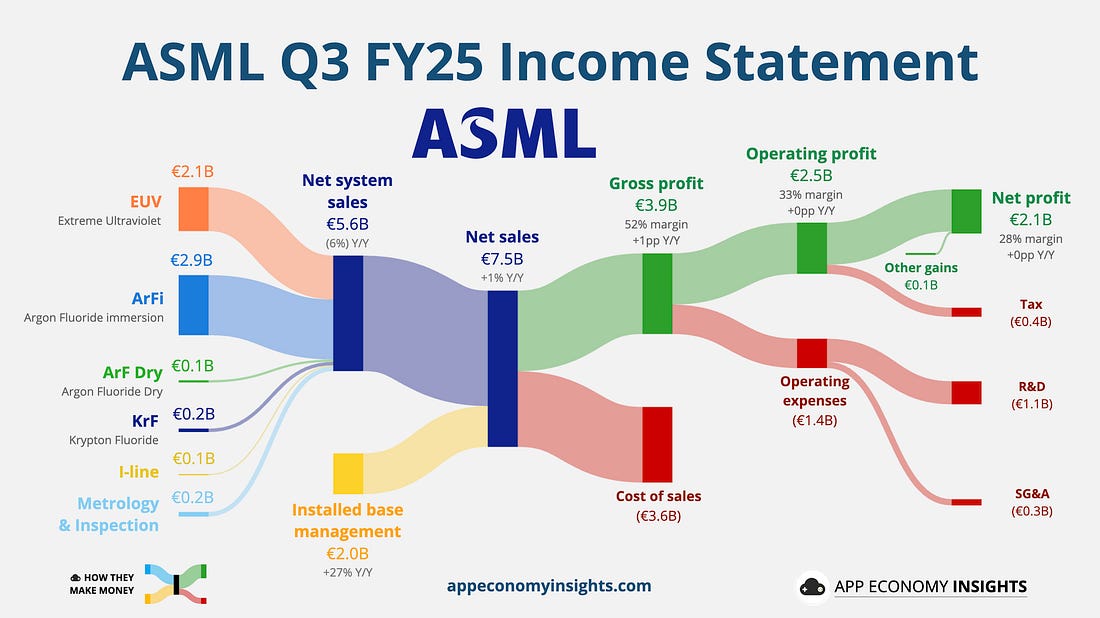
Management reaffirmed its full-year 2025 guidance for 15% revenue growth and 52% gross margin. For 2026, ASML sought to calm investor nerves by stating that sales would “not be below 2025,” establishing a floor after last quarter’s uncertainty. However, CEO Christophe Fouquet explicitly warned that sales to China are expected to decline significantly next year (from 30% of revenue in 2025 down to roughly 25% in 2026), offsetting some of the AI-driven strength.
We have been reducing ASML over the last 12m because it is clear to us that ASML has a EU driven Tech agenda, sits in the crosshairs of US Sino geopolitics, has questionable management vision, and is prone to lumpy cyclical orders. None of these attributes warrant a high valuation multiple. A 0.5 to 2 percentage of NAV sized holding seems correct to us.
We worry about that grey coloured China below shown below:
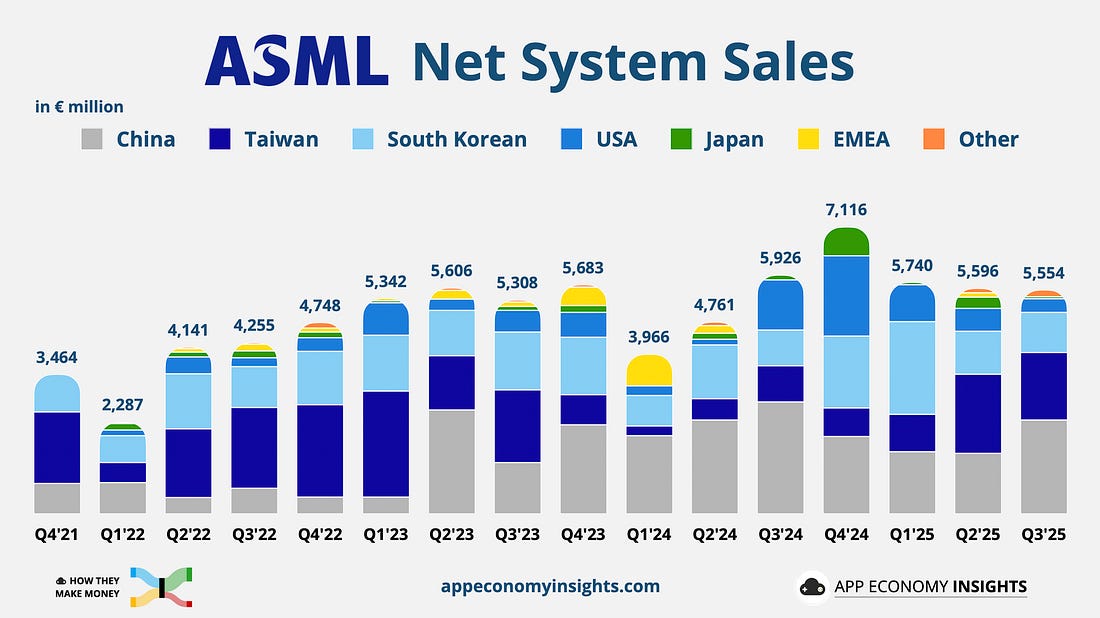
AI-related demand was the clear driver, fuelling the strong EUV bookings as more customers invest in advanced logic and DRAM. However, the China risk has intensified. The region jumped to become the largest market at 42% of system sales this quarter, up from 27% last quarter. The outlook remains a tale of two opposing forces: a booming AI cycle versus a sharp, policy-driven downturn in what is now its largest market.
Liberty Formula One
Total revenue for the first 9 months of the year was reported at $2.9bn, up 16% Y/Y. Despite one fewer race, F1 revenue and OIBDA (operating income plus depreciation and amortization) grew 9% and 15% respectively, with growth across all revenue streams. Nearly all races have seen viewership growth in F1’s top 15 markets, and YouTube highlight viewership increased over 20% in Q3, with the majority of the audience under 35. Management noted that both ticket sales targets and cost minimization efforts for the Las Vegas Grand Prix, are “on track”.
On Media Rights, management described the announcement of Apple as a new broadcaster as a ‘wakeup call’ for other partners around the world. The Apple deal comes at ~2x the Average Annual Value of the expiring 3-year ESPN deal.
Stefano Domenicali, Formula 1 President and CEO: “We completed multiple commercial agreements this quarter and continue to have success accelerating renewals and signing new partners with attractive terms, including our new US distribution partnership with Apple that will highlight the collaborative innovation between our brands for continued growth in the US. Recent strong race renewals and early extensions in key markets including Austin, Azerbaijan and Monaco also demonstrate the value F1 brings to the cities in which we race. We are confident in the next chapter of growth at F1.”
Expect more on FWONK in our next Newsletter.
TSMC
“AI demand actually continue to be very strong […] stronger than we thought 3 months ago. […] The number are insane.“
Q3 revenue jumped 41% Y/Y to $33.1bn, beating estimates by $1.5bn. Operating Margins grew 3% Y/Y to 51%. Growth was fuelled by AI chip orders, with high performance compute increasing to 57% of the overall revenue mix (+6% Y/Y).
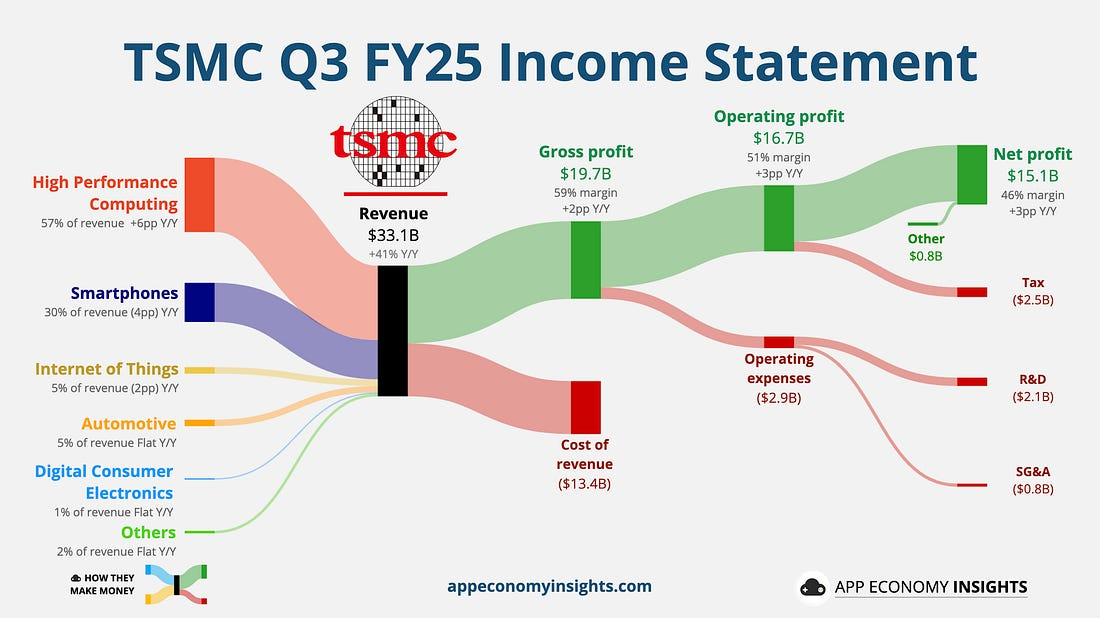
Management raised guidance again, now expecting mid-30% revenue growth in 2025 (local currency), up from ~30% previously. TSMC now sees AI related revenue growth slightly above its 5 year 45% CAGR forecast, driven by token growth and new AI workloads.
“The number of tokens increase is exponential. […] Almost every 3 months, it will exponentially increase. […] That’s why we are still very comfortable that the demand on leading edge semiconductor is real.“
2025 capital spending was raised to $40 billion (from $38 billion), focused on capacity expansion for leading-edge nodes and advanced packaging.
“A higher level of capital expenditures is always going to be correlated with higher growth opportunities in the following years. […] As long as we believe there are business opportunities, we will not hesitate to invest.“
KEY: It is worth remembering that TSMC have a quasi monopoly on AI chip production with strong visibility into customer orders, hence their comments and forecasts on AI demand should not be underestimated.
Microsoft
“We will increase our total AI capacity by over 80% this year and roughly double our total data-center footprint over the next 2 years […] Fairwater (WI) will scale to 2 GW alone.”
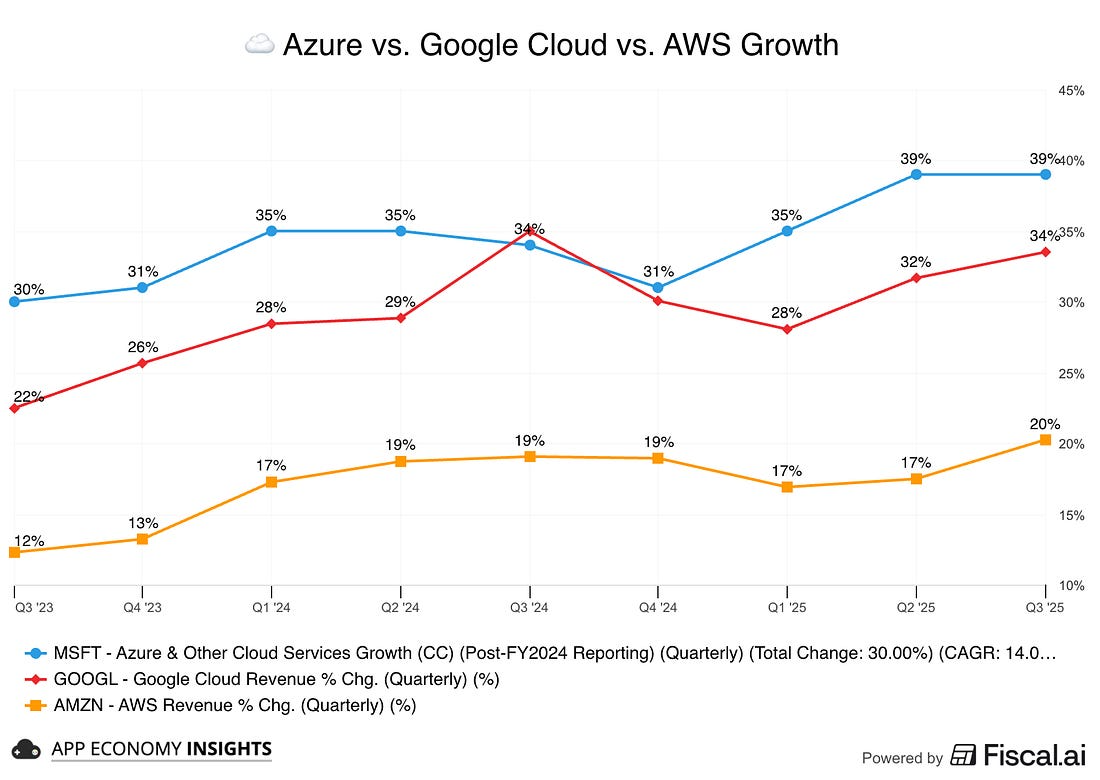
Q1 revenue grew +18% Y/Y to $77.7 billion, a $2.3 billion beat against expectations. Cloud was the main driver, with Azure growing 39% Y/Y. Cloud revenue now accounts for 63% of Microsoft’s total sales mix. The Azure guide for Q2 of 37% growth was tempered due to continued supply constraints rather than any underlying demand slowdown.
“[T]his time we’re behind … earnings are supply constrained by [lack of] power shells”. “We’ve been short capacity for many quarters […] demand is increasing across many places […]“
KEY: Azure growth is still running ahead of both Google Cloud and AWS indicating that Microsoft are continuing to take share.
“We now expect FY26 CapEx growth rate to be higher than FY25.”
Capex grew 74% Y/Y to ~$34.9 billion in the quarter, with roughly half spent on AI chips. Microsoft now expects Capex growth for 2026 to be above 2025, giving some indication of the underlying demand that remains to be unlocked.
“We now have 900 million MAU of AI features […] first-party Copilots surpassed 150 million MAU. […] Copilot chat adoption is accelerating—up 50% Q/Q […] agent users doubled Q/Q.”
On AI agents, we continue to await more meaningful progress on Copilot Studio, its still woeful! Or as diplomats say: improvements have been much more evolutionary than revolutionary.
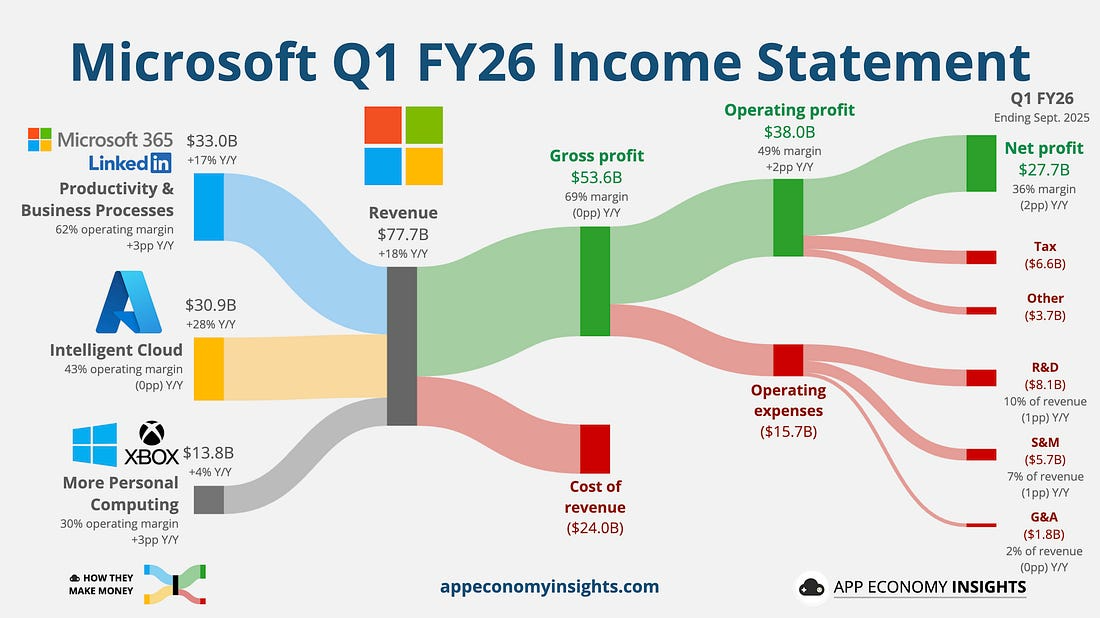
Microsoft also finalised their new agreement with OpenAI in October, entitling them to 27% of the new OpenAI Public Benefit Corporation and commercial rights to OpenAI models through 2032. OpenAI in return is no longer locked into using Microsoft Cloud, although the deal includes a $250 billion commitment by OpenAI to spend on future Azure services. Whilst the terms of the deal were largely in line with investor expectations, the rewritten terms remove a key valuation overhang for Microsoft. Remember, that Mark has predicted that one day OpenAI will be the second most valuable company in the world. THAT is why we are overweight MSFT!
Robinhood
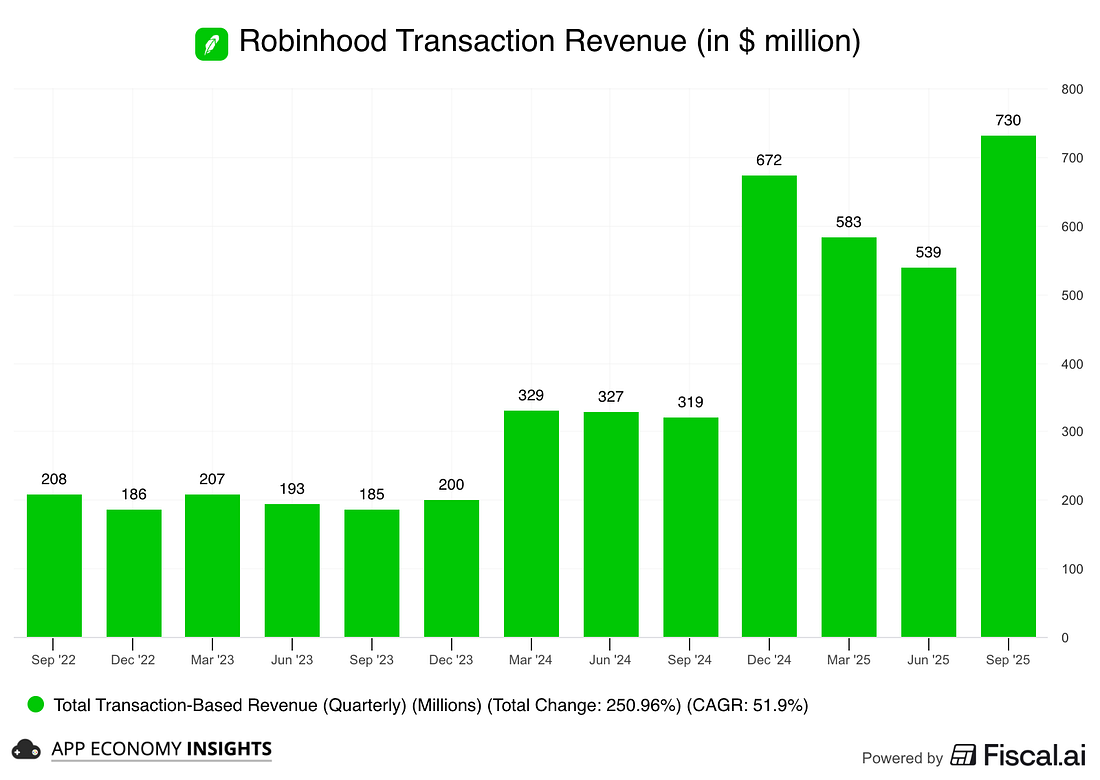
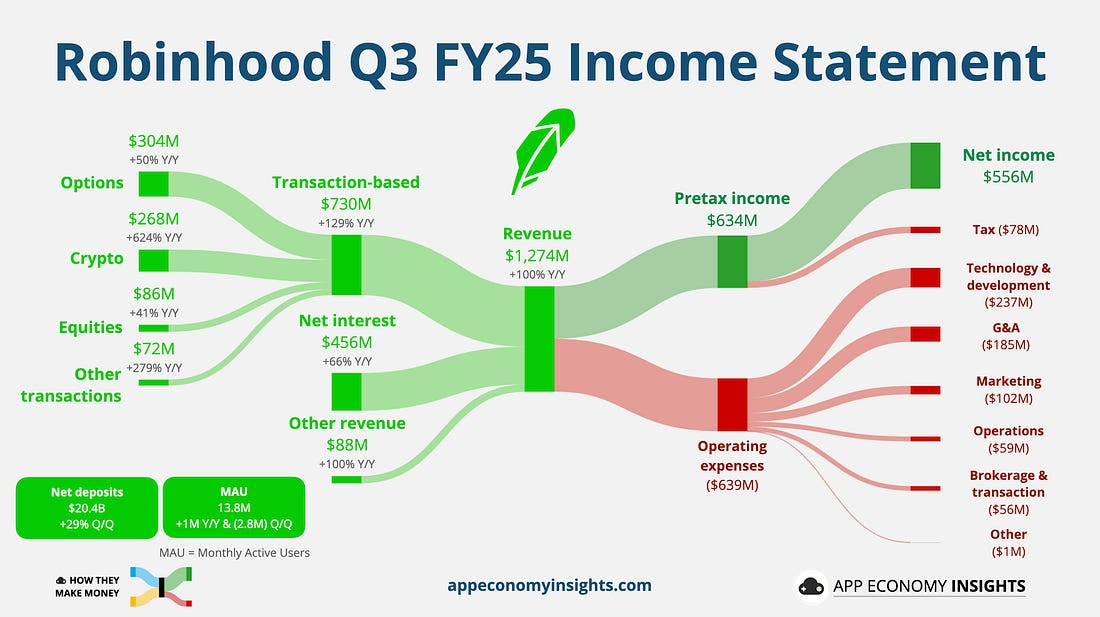
Robinhood’s Q3 revenue doubled Y/Y to $1.27 billion ($50 million beat). Transaction revenue was the main driver, growing 129% Y/Y as trading in crypto (+300%), equities (+132%), and options (+50%) all surged.
Average Revenue Per User (ARPU) accelerated, jumping 81% Y/Y to $191. Robinhood continues to innovate and extend its product offering with new business lines such as Prediction Markets already generating more than $100m in annualised revenue. We are hugely optimistic on the growth in Prediction markets.
“Our team’s relentless product velocity drove record business results in Q3 and we’re not slowing down— Prediction Markets are growing rapidly, Robinhood Banking is starting to roll out, and Robinhood Ventures is coming,”
NVIDIA

We will complete a more detailled analysis of NVDA in our next Newsletter. However, the results were impressive enough to cross the very high bar to drive the after market up.
We would highlight some key points:
- On share of Capex: Nvidia’s CEO says his company’s portion of the build-out is going up. The top Blackwell line is about 30% of the total, he says, with the next generation probably topping that.
- On ASICs and AMD: The CEO adds that the number of customers coming to his company after they’ve looked at other alternatives is actually going up. “And we’re incredibly good, as it turns out, at inference because inference is really, really hard. How could thinking be easy? People think that inference is one shot, and therefore, it’s easy. Anybody could approach the market that way. But it turns out to be the hardest of all because thinking as it turns out is quite hard.”
- How complexity plays to their advantage: Huang says there just aren’t that many teams of chip designers out there. He says Nvidia has shifted to building many components for computers. The number of chips and the diversity of models the components support has increased the complexity of the challenge.
- “Blackwell sales are off the charts, and cloud GPUs are sold out,” said Chief Executive Officer Jensen Huang. “Compute demand keeps accelerating and compounding across training and inference — each growing exponentially. We’ve entered the virtuous cycle of AI. The AI ecosystem is scaling fast — with more new foundation model makers, more AI startups, across more industries, and in more countries. AI is going everywhere, doing everything, all at once.”
- Shift from classical to accelerated compute: “Palantir, is supercharging the incredibly popular Ontology platform with NVIDIA CUDA-X libraries and AI models for the first time. Previously, like most enterprise software platforms, Ontology runs only on CPUs. Lowe’s is leveraging the platform to build supply chain agility, reducing costs and improving customer satisfaction.”
- Use cases expanding: “And it’s not just used for software engineers, it’s used by — because of vibe coding, it’s used by engineers and marketeers all over companies, supply chain planners all over companies. And so I think that that’s just one example and the list goes on, whether it’s OpenEvidence, and the work that they do in healthcare or the work that’s being done in digital video editing, Runway.
- Morgan Stanley: “bullish on implied upside to the $500B Blackwell + Rubin sales through 2026 given ‘incremental’ deals with Anthropic ($30B+) and KSA (400-600K GPUs). Bull Case $300 based on ~30x $10 EPS in CY27, which is arguably conservative.”
- Gemini 3 shows that scaling laws for pretraining are intact. This is the most important AI datapoint since the release of o1. This means that Blackwell models are likely to show a significant increase in performance when they come out in 2Q26.
- The frontier model industry increasingly look like a four player oligopoly. Gemini, OpenAI, Anthropic and xAI so why would we get commodity pricing for an oligopoly or have we forgotten Economics abc? Scale really matters in this battle: Google with Gemini 3 and xAI with Grok 4.1 are beginning to flex their immense infrastructure advantages over all competitors. Yet Journos & Luddites keep talking about some kid in a garage could pop up.
- In a power-constrained world, the headline chip price matters far less than the throughput you can squeeze out of your fixed power budget—i.e., tokens per watt (or tokens per joule). In other words, yes: it’s mostly about TCO and revenue per watt, not sticker price of the chip. So why risk an ASIC development that will for sure have a reduced token per watts ratio than Blackwell or a TPU?
- Optics allow workloads to be moved to where electricity is available and cheap. So no-one will build a DC in the UK!
- The fact that Hopper rental prices have increased since Blackwell became broadly available suggests that GPU residual values might need to be extended beyond 6 years. This will see Hyperscalers do a depreciation write back and Michael Burry explode!
- Even A100s are still generating really high variable cash margins today. If these trends continue, expect GPU financing costs to drop another 100-200 bps which will ease funding concerns.
- People are oblivious to the immense revenue benefits that Google and Meta have seen from moving their recommendation and advertising systems to GPUs from CPUs. Eventhough they keep telling everyone about these benefits, no-one wants to listen.
The opportunity is huge and is laid out in the roadmaps here. If this is the actual outturn, then NVDA has much further to run.


The State of Ai
CRWV management in a recent interview:
“…there is enormous, staggering, and unrelenting demand for compute as the world builds a global computing infrastructure to serve artificial intelligence at a size and scale and magnitude that the world has never seen before…there is no ability to solve the demand profile that is in the market with the capacity that’s available today…That problem is continuing to persist and is honestly worsening. I would say what we’ve observed over the past four to six weeks is yet another inflection in demand.”
It appears pointless arguing against the Bubble Theory as its inevitable no-one will listen.


We have spoken many times about this. The longer duration the function that Ai can undertake the exponentially more tokens that are required. More tokens => more Compute.

…and the Revenue forecasts are starting to build….

Lets take a look at some of the Bear Arguments now.
Circular Financing, no ROIC on Ai and other such nonsense.

The Magnificent 6 have an aggregate Operating Cash Flow of around $700bn per annum to finance this $1.4trn capital investment. That is clearly do-able. When I left university, the Banks were the largest companies in the world. Now it’s the TechCos…the “Magnificent 7 excluding Tesla” (the “Mag 6”) generate roughly 22% of the S&P 500’s total Operating Cash Flow. So where is the most logical place to get the Era of Ai financed?
So where is the return? Ok lets look at this two ways:
Firstly, let’s compute ROI on GPU investment.
We’ll use the profit rate:
• $0.14 profit per 1,000,000 tokens
• GPU cost = $50,000
• Utilization = 55% of each day
• Seconds/day × utilization =
86,400 times 0.55 = 47,520 text{seconds of work/day}
⸻
✅ Step-by-step calculations
Formula: Tokens/day = TPS × 47,520
Then:
• Tokens/year = Tokens/day × 365
• Profit/year = (Tokens/year ÷ 1,000,000) × 0.14
• ROI = Profit/year ÷ 50,000
⸻
12,000 tokens/sec
Tokens/day
12,000 times 47,520 = 570,240,000
Tokens/year
570,240,000 times 365 = 208,137,600,000
Profit/year
208,137.6 text{million} times 0.14 = $29,139.26
ROI
29,139.26 / 50,000 = 58.3%
✔️ ROI ≈ 58%
Question: is that ROIC worth financing?
The second way to look at this question is that it is worth noting that the largest 1,000 global companies by Operating Profit make aggregate profits of ~5% of Global GDP which is roughly $5trn. Operating Margin is about 15 per cent so reversing out total expenditure results in $28 trn and we guesstimate that roughly half of that is Labour => $14 trn.
We have just shown that the fast depreciation assets (within such data centres) being GPUs can create a marginal ROIC of around 58% on reasonable assumptions on profit per token and usage, so the question is what percentage of the $14trn Labour Spend do we save in the future from the investment in Ai or what is the outturn increase in productivity?
Lets take a look at this slide we have produced before:

This slide above shows the Labour savings that can be generated from using Ai could be ~25%. For our exercise, which is a shorter time period, lets make our assumption of Labour savings a more conservative 15% of the Labour Cost which would represent a saving for the top 1,000 companies of ~$2.1trn. In other words, you spend $2.9trn from 2025 to 2028 on Ai investment and save $2.1 trn a year from then onwards. Does that sound a good deal to you?
This is precisely why the SME and the legacy dinosaur companies do not matter. Yes you are correct British Airways is not using AI, but British Airways has still yet not fathomed out how to run a website never mind a mobile application! Forget about these Luddites and focus on what the Forward Thinking MegaCaps are doing as they control the global GDP expenditure $.

“Anthropic serves more than 300,000 business customers, and our number of large accounts—customers that each represent over $100,000 in run-rate revenue—has grown nearly sevenfold in the past year.”
As we keep saying over and over again: Ai is Software 2.0, AGI is a nonsense, Ai needs to increase the productivity of both enterprise and consumer workflows function by function by improving models and agents.
IF we see models and agents continuing to improve, the investment will pay and more investment will follow. IF it does not, then… Yes there is an issue.
General Market Investing
This is what people in Europe just can not understand. The USA is having a soft landing, if any landing. Yes things are slowing a little but not drastically. The commentary from the recent results season was positive and we have snipped two examples from Financials to exhibit this.
Goldman Sachs: “We’re seeing a real pickup in strategic M&A because I think large companies who really have been shut down for the last four or five years and believing that they could not do anything they wanted to do strategically, now actually believe we are in an administration where they can dream big and do things that are significant. We’ve seen a massive pickup in that strategic M&A activity. I think from kind of a secular move, we’re going to have more of a tailwind in terms of M&A and IPO and capital markets activity...if you put it all together, it’s a relatively constructive economic environment.“
Blackstone: “…we see the US economy as really quite resilient. That’s been reflected in corporate earnings in general and certainly in our own portfolio…from a spread standpoint, whether it’s the liquid high-yield markets, IG markets, leveraged loan markets, spreads are sort of a decade-long tight. And then on the CapEx boom side, I think AI-linked spend tech CapEx has been a bigger contributor to GDP growth and consumption. And I think kind of overlaying all this from a sort of general productivity, corporate efficiency standpoint, margin strength standpoint, it’s a very constructive environment…You don’t typically see recessions without erosion in corporate profits. And so, we’re again, I think, quite constructive right now.”
Key Manchester & London Updates
Benchmarking
Some shareholders have asked us which website do we feel it is best for them to visit to review the performance of MNL LN?
We would suggest Citywire and the MNL link is here: https://citywire.com/investment-trust-insider/investment-trusts/trust/manchester-and-london-investment-trust-plc/f782202
Merger Mania
There has been lots going on at Manchester & London since the last newsletter which revolves around:
Corporation Tax Act 2010
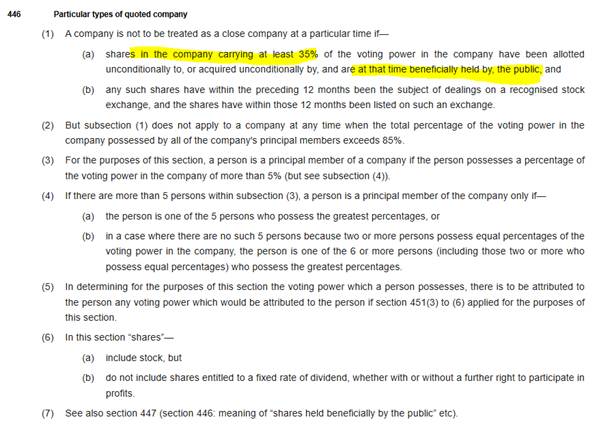
There have been lots of articles stating we WILL LOSE STATUS. These articles are confused, we will only lose status if we buy back more shares and break the 35% threshold. We do not intend to do so, and have not done so.
There also appears to be some confusion about Buy Backs. We have regularly stated that Buy Backs will not sort the issues that lead to a discount describing discount control as like “Canute commanding the tide”. It is a myth that Buying Back shares is a solution to discounts, a myth driven by seductive Activists. MNL bought back ~5 per cent of our Issued Share Capital and our discount widened.
The Real problem: Share of UK household financial assets in equities (national-accounts definition)
Using the national accounts concept AF.5 “Equity and investment fund shares/units” as a share of total household financial assets (AF.A), the UK stood at ~27.2% in 2021, around 10 percentage points lower than in 2000. This AF.5 measure includes both direct shares and indirect equity via fund units, not just listed shares. One can see that the decline was roughly ~0.5% per annum. Believe me you only SHORT stocks with a TAM decline like this. But the worst is yet to come, the latest reading (2025 Q2) is ~15.9%. The decline has accelerated to ~2.5% per annum. I would be staggered if you could find any professional analyst who would not tell you that is the Road to Death.

We have written the below in a previous factsheet – the point we make about the fantastic performance of PCT LN and their need to buy back shares too, is worth further thought. If you tell an American that you have performed with an annualised return greater than 15 per cent for a decade and yet people still sell your stock, they look at you in disbelief.

One solution
As bank deposit rates fall, discounts narrow — which is economically intuitive and supported by historical behaviour:
- When deposit rates are high, investors can earn 4–5% virtually risk-free.
👉 Demand for equity income trusts (yields of ~4–6%) weakens, as the risk premium looks less appealing.
👉 Discounts widen. - When deposit rates fall, that “safe” yield disappears.
👉 Investors start searching for yield again in equities, trusts, and alternatives.
👉 Demand improves and discounts narrow (trust share prices rise faster than NAVs).
This behavioural shift has been visible across past rate cycles — for example:
- In 2019–2021, ultra-low rates saw many income trusts trade at premiums.
- In 2023–2024, with UK base rates around 5%+, discounts in many sectors widened sharply (often to 10–30%).
- Now, as markets start pricing rate cuts, brokers like Numis and Winterflood have commented that discounts should narrowing.
📉 Quantitative Correlation Evidence
Academic and sell-side analyses suggest:
- There’s typically a negative correlation between interest rate level (or deposit yield) and average investment trust discounts.
- e.g., in Winterflood’s historical datasets, a 100bps fall in the base rate has often coincided with 2–4 ppts narrowing in sector average discounts.
Conclusion: IF you believe that interest rates will continue to fall THEN are discounts an opportunity or an issue?
IF interest rates do not fall is that caused by the structure of Investment Trusts OR the ineptitude of a debt ridden, fiscally undisciplined UK government? Are the government punishing personal savings or promoting them?
Solution Two
The debate has lost rational logic and hence proposing rational solutions to the deluded is proving an uphill struggle:

We will keep talking. In the meantime, look what we won:


…and we are paying all shareholders a better dividend…5% yield what is there not to like about that?

But the UK is in a woeful state which is worsening: “UK consumer confidence tumbled in November, with the net score of minus 44 the worst since April”, the BRC said.
…and the Budget approaches.
Key Tweets of the Month


The Long Portfolio


Please watch out for China exposures in Technology portfolios…


PDMRs, Buy backs & the Discount

China, the Tech Wars and the forthcoming Blockade of Taiwan in 2027

Please remember that the best way to way to follow our day-to-day thinking is on our Twitter handle: https://twitter.com/MLCapMan
<td valign="top"
Subscribe to our Newsletters
Each month we share the risks & opportunities we are watching across markets.