
“In matters of style, swim with the current; in matters of principle, stand like a rock.” Thomas Jefferson.
The MNL Swim Team has been in action again, after some training in Corfu: click the photo…

source: https://www.instagram.com/reel/DMqfwQgtmtQ/?utm_source=ig_web_copy_link&igsh=MzRlODBiNWFlZA==
“The optimist sees opportunity in every danger; the pessimist sees danger in every opportunity.” Winston Churchill.
“Most men die at 25, we just don’t bury them until they are 70.” Benjamin Franklin.
Factsheet Commentary

For our full Factsheet, link here.
Q2 Results Season
Every week, we get hounded by people asking us to diversify the portfolio more. Yet:
The Magnificent 7 grew earnings by 26% year-on-year during 2Q, according to Goldman Sachs strategists, compared with 4% for the remaining 493 constituents of the S&P 500.
Arista’s Q2 revenue climbed 30% Y/Y to $2.2 billion ($90 million beat), with AI and cloud demand key drivers. Management now expects $1.5 billion in AI networking revenue for 2025, double prior back‑end targets.
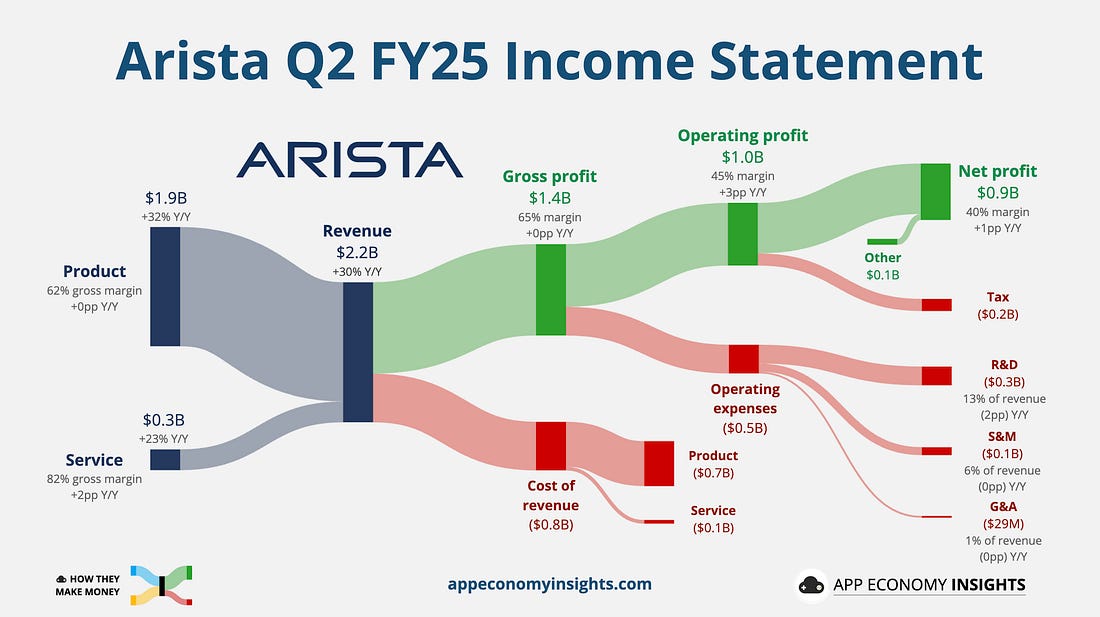
The company raised full‑year growth guidance to 25% (targeting $8.75 billion in revenue) and guided Q3 revenue to $2.25 billion (vs. $2.12 billion expected).
The stock is a similar “picks and shovels” play on the Ai hardware build out as NVDA. Anyone who thinks NVDA will slow down but ANET could carry on with fast growth is deluded and hence supposed diversification is often a myth. ANET has been a winner for us and we run winners (unless something changes structurally).
AMD’s revenue climbed 32% Y/Y to $7.69 billion ($260 million beat).
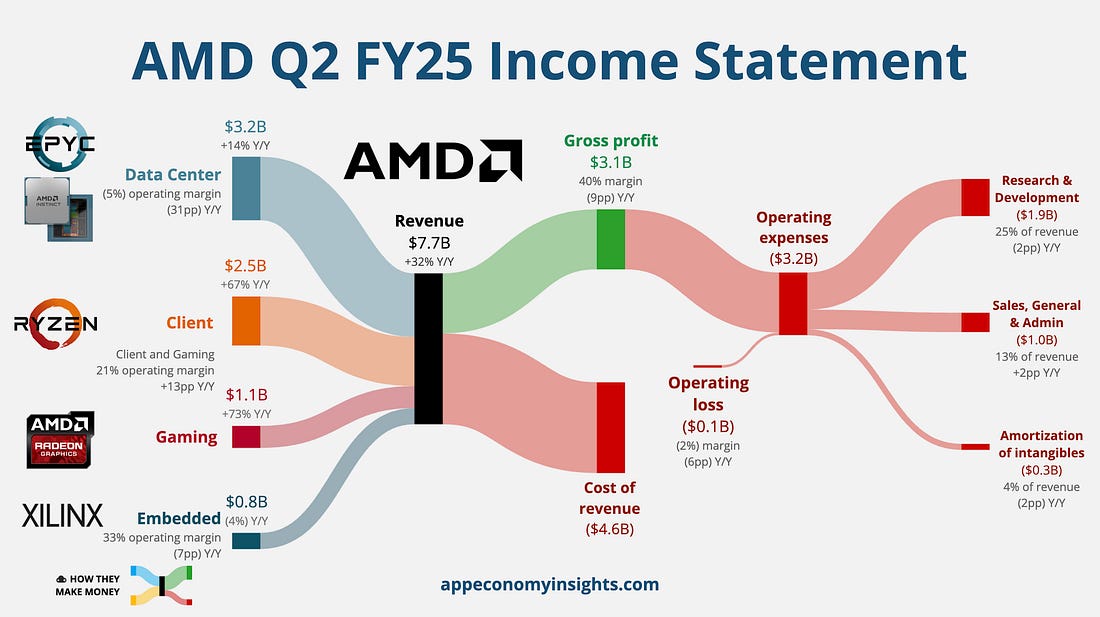
CEO Lisa Su expects “significant growth” in the second half, driven by computing and AI demand. In truth, much of AMD’s success has been due to the ineptitude of Intel, and the easy pickings from this source have now decreased. Now AMD must succeed against NVDA and we see that as a much less probable outturn. However, the market will wish to seek an alternative to its total reliance on NVDA, and hence we see AMD as an ever increasing beneficiary of the continuing Ai hardware growth story.
Robinhood’s Q2 revenue climbed 45% Y/Y to $989 million ($76 million beat), growth was fueled by crypto (+98%), options (+46%), and equities (+65%) trading, alongside a 34% jump in ARPU to $151. Net income more than doubled to $386 million.
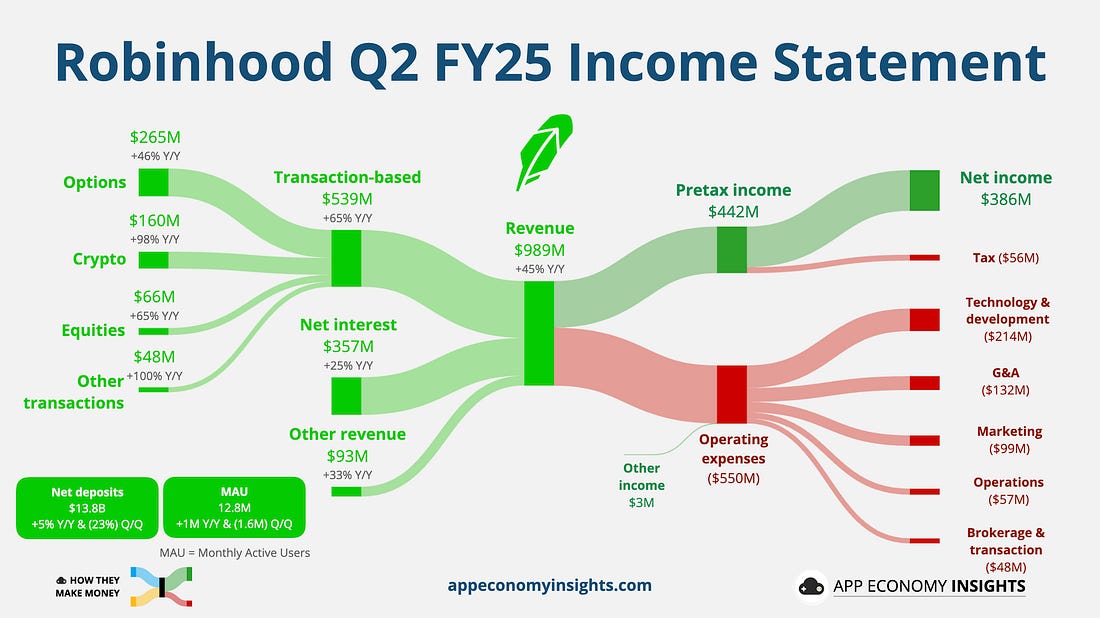
The quarter saw tokenized equity trading for 150,000 users across 30 countries. We see the Event Contracts market and the Tokenized Private Market Equities market as two game changers for this industry and hence, we believe that the European incumbents are impending roadkill. Note it is rumoured that HOOD will be offering UK ISAs soon. Note, we don’t just invest in direct Ai enablers, we also invest in Ai beneficiaries including those that will use Ai to crush the opposition.
If you want to know more about HOOD please click the image below:

Microsoft restructured its business segments last year to better align reporting with current operations:
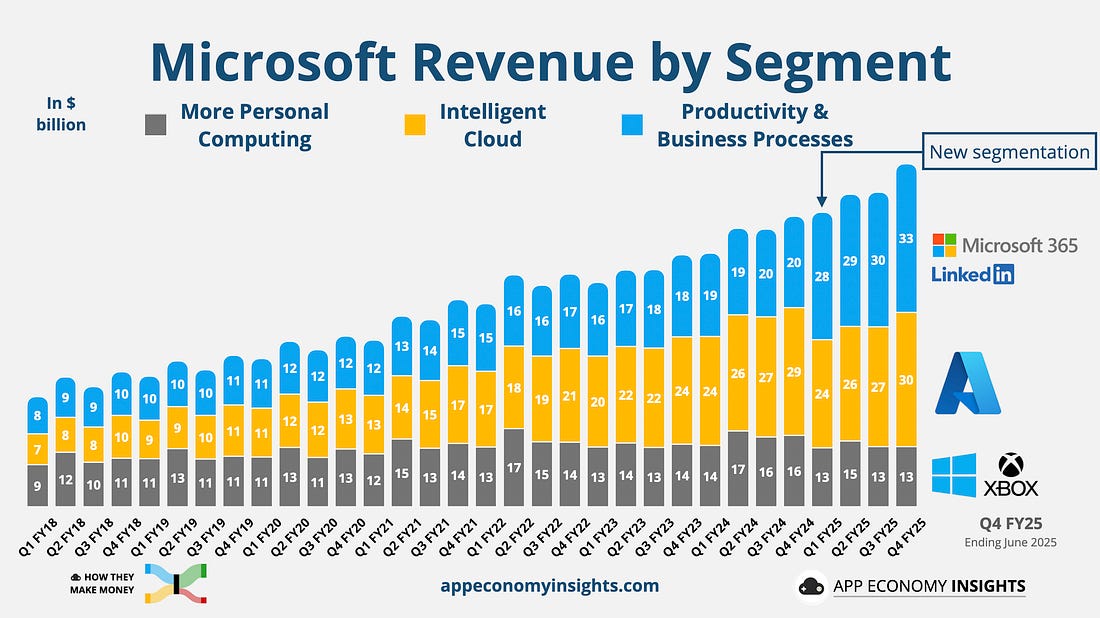
- 📊 Productivity and Business Processes grew 16% Y/Y to $33.1 billion ($1.0 billion beat). M365 Commercial and Consumer drove upside, with Copilot adoption fueling ARPU gains.
- ☁️ Intelligent Cloud grew 26% Y/Y to $29.9 billion ($0.8 billion beat), driven by Azure.
- 🎮 More Personal Computing grew 9% Y/Y to $13.5 billion ($0.8 billion beat), with Search and XBOX content driving the upside.
As we have said many times before, MSFT is a diversified business with 3 discrete divisions and Productivity has some very exciting businesses in data management and cybersecurity.
The division we really love though is Azure which grew 39% Y/Y, far ahead of the 34-35% outlook, driven by core infrastructure demand from large enterprise customers. Azure sales reached $75 billion in the past 12 months (+34% Y/Y). For context, Google Cloud was $49 billion and AWS $112 billion as of March and Azure is taking share from AWS at a fast clip.
“For the first time commercial bookings were over $100 billion […] driven by strong execution across our core annuity sales motions and long-term commitments.”
A record backlog of $368 billion gives Microsoft multi‑year revenue visibility and validates its aggressive AI CapEx ramp.

We are very happy with the investment MSFT made in OpenAI which we believe could become extremely valuable and hence a fourth leg to the diversification stool. Microsoft is in the middle of a CapEx supercycle, building gigawatt‑scale data centers to meet AI demand and we see demand for such cloud computing stretching ahead for a number of years yet. However, we remain disappointed with co-pilot which needs fast and radical development improvements. We would start weeding out some of the old guard in the co-pilot team like Charles Lamanna. No Charles your co-pilots are not awesome, and we are bored of hearing that they are, when they are not!
Intuitive Surgical’s Q2 revenue rose 22% Y/Y to $2.4 billion ($90 million beat), and adjusted EPS jumped 23% to $2.19 ($0.27 beat), driven by 17% procedure growth and accelerating da Vinci 5 adoption. The company placed 395 systems (up from 367 in Q1), including 180 da Vinci 5 units, bringing its global installed base to over 10,000 systems. Recurring revenue made up 85% of the total. This is an Installed Base stock with a huge TAM as human driven surgery moves to robot assisted.
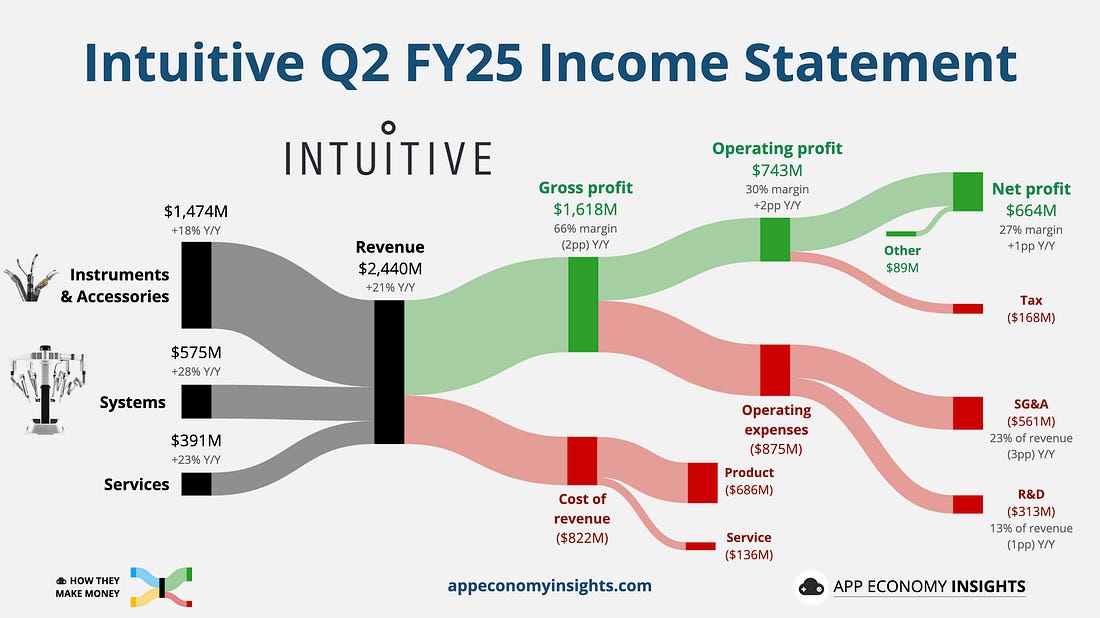
Procedure growth guidance ticked up to 15.5%-17%, with strong US general surgery. The stock has not been performing due to fears that relations with China will sour which will slow international sales and that tariffs will compress margins. Both these fears are valid concerns but we see the long term prospects for this stock as very attractive.
ASML, the largest European tech company, grew net sales 23% Y/Y to €7.7 billion (€200 million beat). Bookings rebounded to €5.5 billion (€1.3 billion beat), including €2.3 billion in EUV orders. Gross margin held steady at 54%, helped by a High-NA system delivery (the most advanced machines) and upgrade mix.
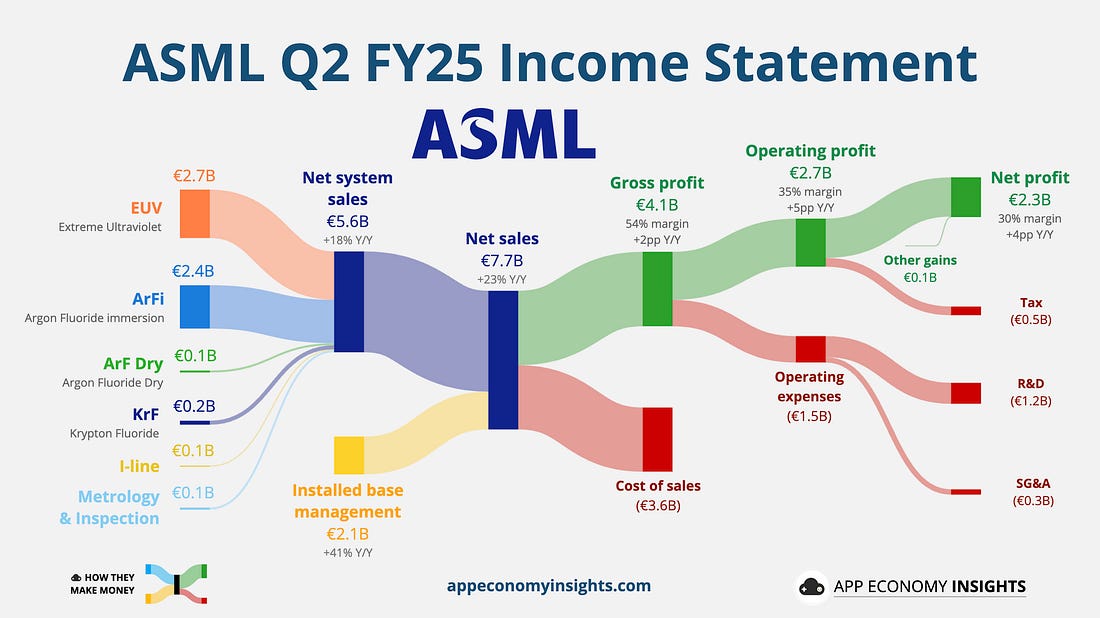
Management reaffirmed full-year 2025 guidance for ~15% revenue growth and ~52% gross margin, but struck a more cautious tone on 2026. CEO Christophe Fouquet cited “increasing macro and geopolitical uncertainty,” warning that growth next year is no longer a given. Tariff concerns loom large, especially for US-bound shipments, imported materials, and potential retaliatory measures, and the management have been caught offside by TSMC’s ability to continue to expand without the expected high capital spend with ASML.
We had reduced our holding in ASML over the Quarter from being a Top 5 holding to now being 2 per cent of the portfolio. ASML has great technology but the management can be flat-footed commercially and orders are extremely lumpy.
FWONK is a stock that has done very well for us. The graphic shows you the components of how it made money in 2023.

Visual by App Economy Insights
This is a fast growth, high margin business with viewers/customers/subscribers who have a great demographic mix.
Recent results did not disappoint. Q2 2025 Results vs Year-Ago Quarter: Revenue rose to $1.341 billion, up 35.7% from $988 million in Q2 2024. F1: The Movie smashed expectations with a strong domestic and global debut; its escalating box office trajectory (approaching $600 million) signals robust market appeal. We believe there is further to run for this brand driven stock as it expands further into the USA and hospitality.
Note again, we don’t just invest in Ai Enabler stocks, although we guess that Ai will play a good part in this stock’s future success.
Conclusion
I do hope you have been clocking all those Growth rates above, because we are Growth investors whose portfolio has a forward looking Sales growth rate of over 15 per cent and an EBITDA growth rate of over 18 per cent. Growth is what moves portfolios, not Value. BTW, the forward EV to EBITDA ratio is 19x, so we would argue we present growth at a reasonable price.

The State of Ai.
By now, the Denialists had told us the Bubble would have burst because the temporary mania of buying Ai hardware would have deflated, but the outturn is…

…and the Brokers are moving Cloud Capex forecasts up…

Please note, we believe that the point made below is key:

…and finally…
Whilst it is the story of today, the MIT NANDA report, “The GenAI Divide: State of AI in Business 2025.”
We think this is a small sample, subjective, non report. However it makes two brilliant points which we have made repeatedly.

We have repeatedly said that all these financial institiutions who have banned ChatGPT, to develop their own AI are very dumb and will waste 100 per cent of their investment. I made this very explicitly clear when I spoke at the Winterflood conference in Edinburgh. In fact, any undergraduate who has done a Software Development module will tell you the same. Most banks ban ChatGPT and employees have to use a third rate, self developed model.
Secondly, we have run Shorts on Intuit on a number of occasions for precisely the second reason snipped above. Most of the agents we have coded and got working in our business are in the back office. Software 2.0 is function specific, like Software 1.0. We have said for years that talk of AGI is nonsense. IT costs are exactly what they say on the tin: “costs”. They make your business more process expedient and more function efficient, that is what they have always done. To paraphrase Alex Fergusson: “Brilliant goalkeepers are not meant to score goals.” The idea of Ai is that you automate away your overhead so you can reinvest that capital in R&D and advancement and hence drive productivity.
Some very confused people seem to think Ai is about developing a humanoid robot, super salesman. Now if you feel this restriction may reduce the TAM for AI, please don’t worry as in modern businesses with an employee count of say 100 workers there will only be around 5 workers that actually “create the rain”. Those 5 will never be disrupted by Ai, its the other 95 that are the TAM.
So, only confused people use images like the below:

Having said all that, Robotics is becoming very interesting for the automation of the Manufacturing & Distribution industries.
Yes — a major wave of investment in robotics is both underway and accelerating in the U.S., driven by exactly the forces you mention:
🧱 Structural Forces Driving U.S. Robotics Investment
Force
Impact
1. Industrial policy & tariffs
U.S. tariffs on Chinese electric vehicles, semiconductors, and solar (2024–25) raise input costs and create strong onshoring incentives. U.S. manufacturers now need automation to stay cost-competitive.
2. CHIPS Act, IRA, IIJA
These stimulus laws inject $1.2 trillion+ into domestic infrastructure, energy, and semiconductor capacity — all of which require high-throughput, low-cost fabrication and logistics, ideal for robotics.
3. Labour shortages
U.S. unemployment is low (3.9% as of July 2025), and construction/manufacturing see persistent skill gaps. Robots fill jobs that companies can’t hire for — especially in warehousing, logistics, welding, and food processing.
4. AI breakthroughs
Foundation models now control multi-purpose robots (e.g. Figure, 1X, Tesla Optimus). The marginal cost of flexible automation is falling fast, allowing smaller firms to deploy robotics for the first time.
5. Regulatory streamlining
New U.S. planning rules under the Biden administration accelerate approvals for clean-energy, data-centre, and fab sites, creating demand for robotic deployment in tight timelines.
📈 What we’re seeing in 2025
-
Capex Surge:
U.S. private manufacturing construction is at record highs: $225+ billion/year, nearly triple the pre-2020 average. Robotics and automation are a large beneficiary. -
Warehouse Robotics Boom:
Amazon, Walmart, and Target are now deploying tens of thousands of AMRs (autonomous mobile robots) for order fulfillment. Small warehouses are adopting “robots-as-a-service” to compete. -
Humanoid & Mobile Manipulator Pilots:
Companies like Figure AI, Sanctuary, and Apptronik are now piloting humanoid robots with logistics and automotive giants. Tesla’s Optimus is being tested internally in Fremont. -
VC & Corporate Investment:
Funding for U.S.-based robotics startups exceeded $9.3 billion in 2024, up 52% YoY. Amazon, Nvidia, Microsoft, and OpenAI are all investing in general-purpose robotics stacks.
🧠 Why this time is different
-
It’s not just fixed-arm automation anymore.
AI is enabling low-cost, flexible robotics that require less infrastructure and training. -
Robotics ROI is getting short enough (~1–3 years) that even SMEs are deploying them — not just GM and Intel.
-
Every planning bottleneck and geopolitical shock (Taiwan risk, Red Sea disruptions) makes local, resilient, automated production more attractive.
✅ Outlook
This decade is likely to see a step-function increase in U.S. robotics investment, especially in:
-
Manufacturing (semiconductors, EVs, renewables)
-
Construction (modular assembly, layout, QA)
-
Logistics (warehousing, last-mile)
-
Defense (attritable and autonomous systems)
Yes, the convergence of tariffs, subsidies, and regulatory reform is not just likely to drive a robotics boom — it’s already happening.
Would you like a tracker of the major U.S. robotics players or examples of public companies most leveraged to this theme?

…so we have bought some of the ROBO ETF that we have held on several occasions before.
General Market Investing
With thanks to a friend at Rothschild & Co. who sent me a fantastic article providing mathematical proof alongside anecdotes of the greatest art dealers in history on why selling your winners (or best performers) is illogical. So you have to ask yourself, why do so many people want us to sell our best performing stocks? The article should be read and can be found here.
This reinforces the work that Baillie Gifford published in 2019 called Lessons from Bessembinder.
o4 summary below:
Professor Hendrik Bessembinder, whose research—cited by Baillie Gifford in their “Lessons from Bessembinder” report—finds that only a tiny fraction of companies generate virtually all stock market wealth creation.
📑 What the Bessembinder Research Found
-
Bessembinder’s study analyzed over 26,000 US-listed companies from 1950 to 2019.
-
It showed that just 0.3% of stocks delivered all the net gains in excess of US Treasury bills, meaning that 99.7% of firms underperformed safe cash or added no net wealth. (media.bailliegifford.com)
-
In a global sample (1990–2018), a similarly small minority—less than 1% of stocks—accounted for nearly all net profit above holding cash internationally. (Finimize)
🏛️ Baillie Gifford’s Perspective
-
Baillie Gifford summarized these findings in a report titled “Lessons from Bessembinder”, showing how their own investment philosophy—focused on long-term concentrated growth investing—aligns with this research. (media.bailliegifford.com)
-
Their strategy philosophy emphasizes backing future “superstar” companies over broad diversification, as these handful of winners drive outsized returns. (Finimize)
🧠 Broader Implications
-
Investor take-away: Consistently outperforming often hinges on finding and holding the rare outlier stocks. Passive index investing captures average returns—but misses the deeply skewed nature of wealth creation. (Finimize)
-
Bessembinder suggests that the “equity premium” may largely stem from these rare winners, not broad market exposure. (Baillie Gifford)
✅ Summary
Feature
Key Finding
Proportion of stocks driving net gains
~0.3–1%
Insight
Market returns are extremely skewed—only a few firms produce outsized wealth
Baillie Gifford takeaway
Reinforces their concentrated-growth approach—bet on long-term, exceptional winners
+
This combines with our observation that so many of these “advisers” fail to understand that the Long-Term investor has historically created the best investment returns by Large CapTechnology investing…

…and, according to BlackRock, this time it might even be better…

…but Tech investors do the very best when interest rates are falling…and the US Labour market now suggests that could happen…

…this is what Mike Wilson at Morgan Stanley has to say…
“Ultimately, we think tariff-related inflation will be temporary (our Economics team agrees), and tariffs could even be disinflationary/demand destructive in certain industries—i.e., in consumer where pricing power is elusive. As a result, we think the Fed will eventually transition to cuts. However, a delay of those cuts in the face of weaker growth data could lead to a correction in equity markets. As discussed previously, we’re buyers of dips, and Friday may be all we get to the downside for now—i.e., until the next payroll number or other weaker, lagging growth data is potentially revealed.
…Bottom line, economic data is backward looking, earnings revisions and equity markets are forward looking. April was a major low that discounted the data we are seeing now. Remember that unemployment typically rises for many months AFTER the market bottoms in a recession. Once the growth risk is priced, it’s ultimately a tailwind for margins and stocks as positive operating leverage arrives and the Fed cuts significantly.”
…and with the Consumer Staples trade broken, there only remains the Tech trade…

Key Manchester & London Updates
As for MNL…

Our Financial Year End is to July…first draft of performance…

…so our annualised long term performance should be looking better than the end of 2024…

Key Tweets of the Month
The growth continues…

…but there is a long way to travel yet…so are you sure you should be selling now?

We keep saying it’s not about how disappointing -5 is, its about the decline in Humans…

So the old ways will die….

…and stock picking gets tough…

The inflation narrative is wrong – read this article (click image)…

…and if rates come down, long duration assets (like Tech) tend to do very well…

…and the heavy adopters will be saved from their Debt through Productivity (click the image)…

Soon they will be forced to rewrite Economic Theory for the new Era of the Machine…

…but by then the City will be dead anyway.

The Long Portfolio

Watch out for China exposures in Technology portfolios…


PDMRs, Buy backs & the Discount
All the Technology funds are returning capital as the volatility scared sell…

China, the Tech Wars and the forthcoming War of Taiwan in 2027

Another worth watching, video on the belligerence of China (click the link or the video).
How China Is Quietly Bracing for Conflict With India | WSJ Coordinates
https://youtu.be/t5U5InvvlXI?si=1hJwgMt0DSiNJFgY


Please remember that the best way to way to follow our day-to-day thinking is on our Twitter handle: https://twitter.com/MLCapMan

<td valign="top"
Subscribe to our Newsletters
Each month we share the risks & opportunities we are watching across markets.